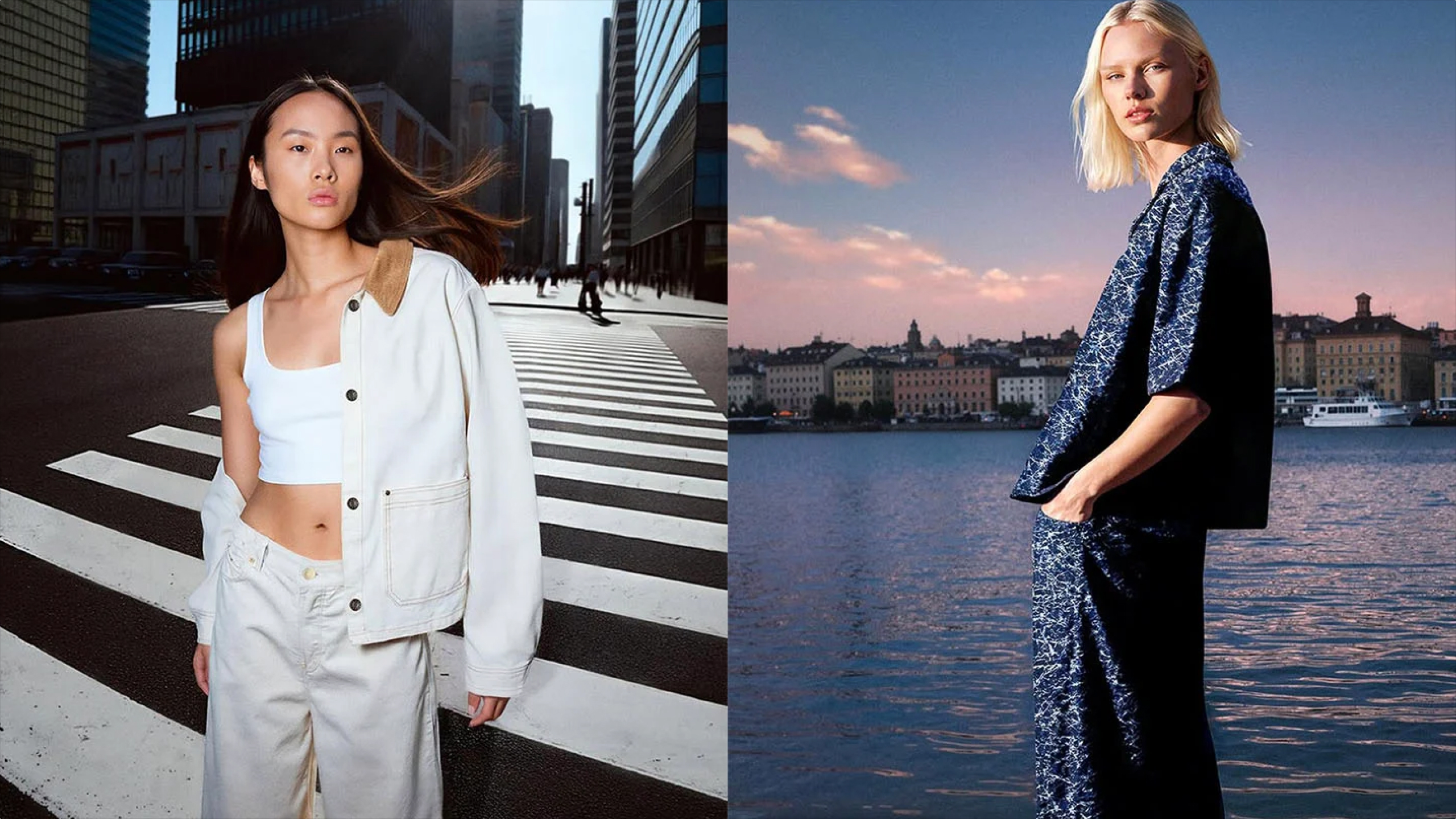
Fashion advertising is entering a new era.
From Benetton to Guess and H&M, brands are increasingly exploring AI-generated imagery as part of their creative and marketing strategies. Campaigns that once required international travel, studio bookings, production crews, photographers, models, stylists, and weeks of post-production can now be developed, tested, and sometimes fully produced in a fraction of the time.
The reasons are obvious. AI reduces costs, accelerates production, and allows creative teams to explore more ideas before committing significant budgets and resources. In an industry where brands are expected to create content across websites, social media, e-commerce platforms, digital advertising, and multiple markets simultaneously, the ability to move faster has become a significant competitive advantage.
For many marketers and creative teams, AI feels like one of the most important shifts in visual production since digital photography. It removes barriers that have traditionally limited experimentation and gives brands the freedom to test, refine, and scale creative concepts with unprecedented speed.
But as AI becomes more deeply integrated into fashion advertising, a more interesting question begins to emerge.
Not whether brands can use AI but when they should.
The Case for AI Advertising
Much of the discussion around AI advertising tends to focus on what might be lost. Less attention is given to what becomes possible.
For many brands, AI is creating opportunities that simply did not exist before. Campaign concepts can be explored before a photoshoot is planned. Visual directions can be tested across multiple audiences and markets. Smaller brands can access a level of creative production that was previously reserved for companies with far larger budgets.
In this sense, AI is not replacing creativity. It is reducing the operational barriers that often stand between an idea and its execution.
That distinction matters.
The technology itself does not generate a brand strategy, define a creative vision, or understand what makes a campaign culturally relevant. What it does exceptionally well is help teams move from concept to execution more efficiently. When used thoughtfully, AI allows creative professionals to spend less time navigating production constraints and more time focusing on ideas.
For companies operating in highly competitive markets, that shift is significant. The ability to test more concepts, create more variations, and respond more quickly to changing consumer demands has clear business value.
This is one of the reasons AI adoption is accelerating across the fashion industry.
Not because brands are trying to eliminate creativity but because they are trying to unlock more of it.
Advertising Has Always Been About More Than the Final Image
At the same time, fashion advertising has never been solely about producing beautiful visuals.
The most memorable campaigns are rarely defined by technical perfection alone. They succeed because they capture something larger than the product itself: a feeling, a cultural moment, a point of view, or a story that resonates with people.
Behind those campaigns are photographers, stylists, art directors, models, producers, and countless creative decisions that shape the final outcome. What audiences connect with is often not just the image itself, but the human interpretation behind it.
This is where the conversation around AI becomes more nuanced.
When AI enters the advertising process, it does not only reduce production costs. It also changes the role of the people who have traditionally contributed to the creation of campaigns. In some cases, that means removing repetitive tasks and creating more space for strategic and creative work. In others, it raises questions about whether efficiency is replacing forms of collaboration that have long been central to the industry.
The challenge is not that AI can create compelling imagery.
Increasingly, it can.
The challenge is understanding which parts of the creative process benefit from automation and which parts still depend on human experience, intuition, and cultural understanding.
Where Should Brands Draw the Line?
The answer will not be the same for every campaign.
Using AI to explore concepts before production, generate creative variations, localize assets for different markets, or support content creation at scale presents clear advantages. In these cases, AI functions as an extension of the creative team rather than a replacement for it.
The conversation becomes more complex when AI begins replacing people whose contribution extends beyond execution and into the creative meaning of the work itself.
Advertising has always been more than a production process. It is also a reflection of culture, identity, and representation. The choices brands make about who creates campaigns, who appears in them, and whose stories are told have always carried significance.
AI does not remove that responsibility. If anything, it makes it more important.
As the technology becomes more capable, brands will increasingly need to make intentional decisions about where efficiency creates value and where human participation remains essential.
Representation in the Age of AI
Representation is perhaps one of the clearest examples of this challenge.
Some brands are already exploring frameworks that allow models to retain ownership of their digital likeness and receive compensation when it is used. These approaches recognize that identity itself has value and that technological innovation should not automatically come at the expense of the people who help create that value.
At the same time, the rise of AI-generated people introduces new questions.
On the surface, synthetic diversity can appear to solve longstanding representation challenges. Different ages, ethnicities, body types, and aesthetics can be generated almost instantly and adapted to fit virtually any campaign.
But representation has never been solely about appearance, it is also about participation.
It is about ensuring that opportunities, visibility, and economic value are shared by real people rather than simulated versions of them.
An image can look inclusive without necessarily creating inclusion.
As AI-generated advertising becomes more sophisticated, this distinction will only become more important.
The Difference Between Creation and Replication
AI is remarkably effective at generating possibilities.
It can produce countless variations of an idea, combine visual references, accelerate content production, and help brands scale creative output in ways that would have been difficult to imagine only a few years ago.
But there remains an important distinction between generating content and creating meaning.
Technology can produce images but people determine why those images matter.
The strategic direction, cultural awareness, emotional intelligence, and creative judgment that shape successful campaigns still originate from human decisions. AI can support those decisions, amplify them, and help bring them to life more efficiently, but it cannot replace the intention behind them.
This is why the most effective use of AI is often not the most visible.
The strongest implementations do not remove creative thinking from the process. They create more space for it.
The Future Is Not AI or Human. It Is AI and Human.
At AIUTA, we see AI not as a replacement for creative teams, but as a powerful extension of them.
As an AI content creation studio, our perspective is simple: the goal is not to eliminate people from the creative process. The goal is to remove unnecessary production barriers so that ideas can move faster, experimentation becomes easier, and creative teams can focus on higher-value work.
AI is exceptionally effective at scaling content, accelerating production, and unlocking new forms of creative exploration. Those advantages are real, and for many brands they are becoming increasingly difficult to ignore.
But the value of advertising has never come solely from efficiency.
It comes from perspective.
From taste.
From understanding culture.
From knowing not only what can be created, but why it should exist in the first place.
The future of fashion advertising will not be fully human or fully AI, it will be a combination of both.
The brands that succeed will not necessarily be those that automate the most. They will be the ones that understand where technology creates value and where human creativity remains irreplaceable.
Because the real question is no longer whether AI belongs in advertising. It already does.
The question is how to use it in a way that makes creative work better, rather than simply faster.
FAQ
What is AI advertising?
AI advertising refers to the use of artificial intelligence to support or generate advertising concepts, imagery, video, copy and other creative assets.
How are fashion brands using AI in advertising?
Fashion brands are using AI to explore campaign concepts, generate visual content, create variations, localize assets and accelerate creative production across different channels and markets.
Is AI-generated fashion advertising ethical?
AI-generated advertising raises questions around transparency, representation, copyright, consent, likeness and the role of human creatives. Responsible use depends on how the technology is sourced, deployed and disclosed.
Does AI replace creatives in fashion advertising?
AI can automate parts of the production process, but creative direction, cultural understanding, strategy and human judgment remain important to successful fashion advertising.
How can fashion brands use AI responsibly?
Brands should establish clear guidelines around consent, likeness, representation, intellectual property, transparency and human oversight while ensuring AI supports rather than unnecessarily removes creative participation.
%20(2).jpg)