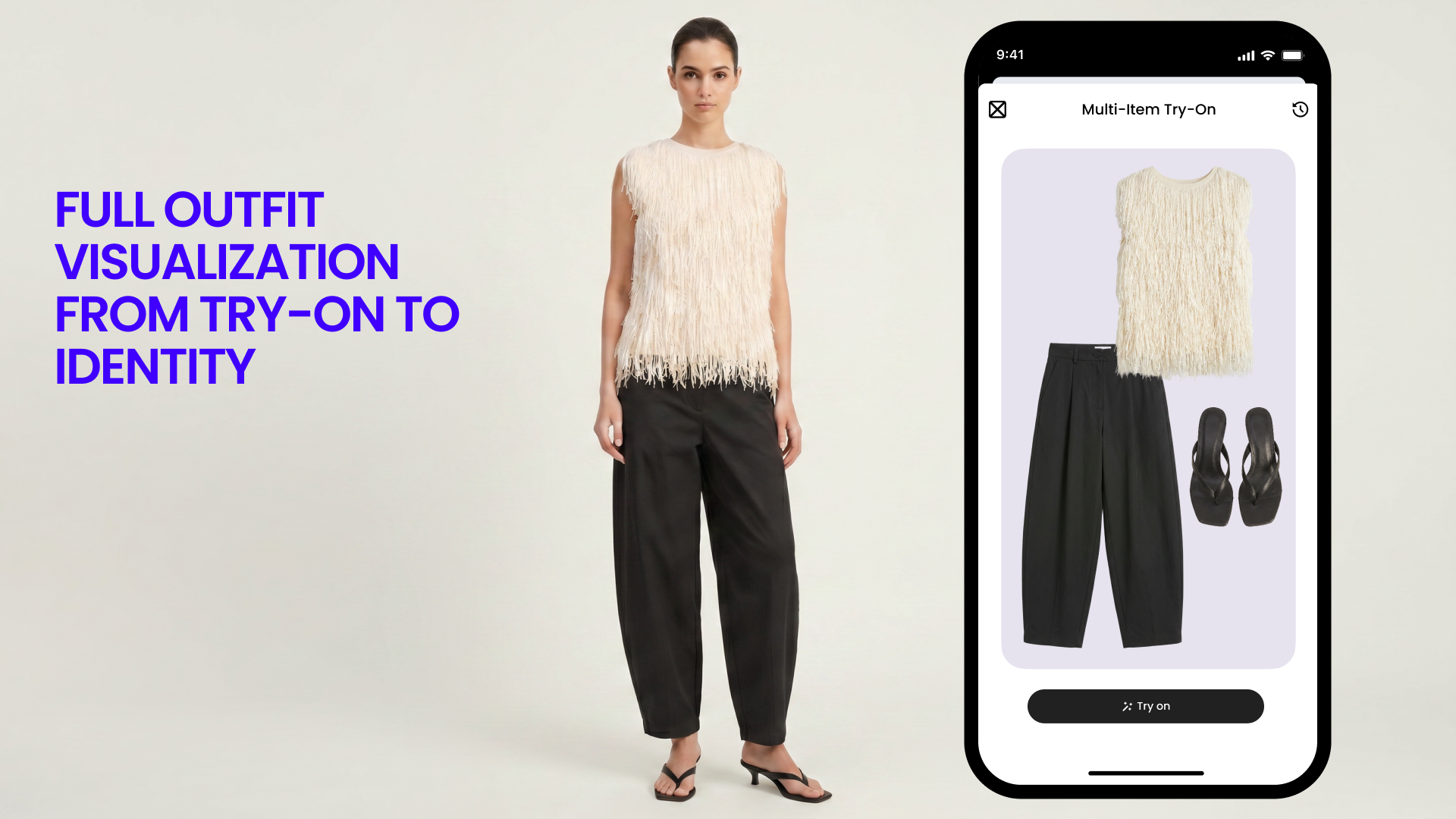
Full Outfit Visualization is the next evolution of Virtual Try-On (VTO) technology. While traditional VTO allows users to preview individual clothing items on their body, full outfit visualization enables users to see a complete styled look, jackets, pants, shoes, and accessories, rendered together on themselves in real time.
This shift fundamentally changes online shopping from evaluating garments to evaluating identity.
Instead of asking:
- “Does this fit?”
Users begin asking:
- “Is this me?”
This transformation is reshaping engagement, conversion rates, and consumer decision-making in fashion e-commerce.
From Product Evaluation to Identity Experience
Traditional online fashion shopping forces users to mentally assemble outfits from isolated items. Jackets, trousers, shoes, and accessories are shown separately, creating cognitive fragmentation.
The Problem with Isolated Product Views
- High cognitive load
- Lack of stylistic coherence
- Uncertainty in outfit compatibility
- Increased decision fatigue
Full Outfit Visualization solves this by reconstructing a complete look directly on the user’s body.
The Shift in Thinking
- From product-level evaluation to identity-level simulation
- From “Do I like this item?” to “Do I like this version of myself?”
People naturally think in complete outfits, not isolated garments. This makes full outfit visualization more aligned with real human decision-making.
The Mirror Effect in Virtual Try-On Technology
One of the most powerful aspects of full outfit visualization is the mirror effect, where users see a realistic version of themselves wearing a complete outfit.
This creates a psychological feedback loop rather than a passive viewing experience.
Key Psychological Drivers
1. Self-Consistency Bias
Users prefer versions of themselves that align with their identity narrative.
2. Aspirational Projection
Users imagine improved or future versions of themselves.
3. Emotional Anchoring
Complete outfits trigger stronger emotional responses than individual items.
Together, these effects increase confidence and accelerate decision-making.
Virtual Try-On and Fashion E-Commerce Data
Virtual Try-On and AR fashion systems have already demonstrated measurable business impact:
- 20% to 40% conversion rate increases in AR and VTO implementations
- Around 27% average uplift reported in Shopify AR deployments
- Up to 32% plus conversion improvements in optimized retail systems
- In-store AR experiences showing up to 250% uplift in some cases
However, fashion returns remain high, with around 40% of apparel returns driven by size and fit uncertainty.
Full Outfit Visualization addresses not only fit, but also style coherence and identity alignment.
Cognitive Shift, From Evaluation to Self-Simulation
Full outfit visualization transforms how users think during shopping.
Instead of evaluating products individually, users simulate themselves in complete styled identities.
Behavioral Shift
- “Do I like this jacket?”
→ “Do I like this version of me?”
This leads to:
- 20% to 65% higher engagement
- Longer browsing sessions
- Increased purchase intent
This phenomenon can be described as identity simulation time, where prolonged exposure to a coherent self-image increases psychological commitment.
Reduced Cognitive Load in Fashion Decision-Making
Full outfit visualization reduces mental effort by removing the need to assemble outfits manually.
Benefits
- Faster decision-making
- Lower decision fatigue
- Higher purchase confidence
- Stronger emotional attachment
This mirrors the role of professional stylists who think in complete looks rather than individual pieces.
The Dopamine Loop of Digital Fashion
Fashion shopping is closely tied to reward prediction systems in the brain.
Full outfit visualization enhances this loop by showing users a socially coherent version of themselves in real time.
Outcomes
- Faster purchase decisions
- Higher conversion rates
- Increased return visits
- Stronger emotional engagement
Shopping becomes less about selecting products and more about iterating identity versions.
Impact on Returns and Purchase Confidence
Virtual Try-On systems already reduce return rates by 15% to 40%, depending on implementation quality.
Full outfit visualization further improves this by increasing psychological commitment to the final decision.
Once a complete outfit is accepted:
- Uncertainty decreases
- Confidence increases
- Post-purchase regret reduces
From E-Commerce to Identity Simulation Systems
Full outfit visualization represents a shift from traditional e-commerce to identity simulation platforms.
Future systems may include:
- Context based styling (work, weekend, events)
- Adaptive outfit generation based on behavior
- Social perception simulation
- Persistent evolving fashion identities
E-commerce becomes a system for exploring possible versions of the self.
Conclusion, Psychological Coherence Drives Conversion
The most important innovation in full outfit visualization is not visual realism, but psychological coherence.
Users are no longer evaluating clothing items in isolation. They are evaluating complete identities.
The key question in fashion e-commerce is evolving:
- From: “Do I like this outfit?”
- To: “Does this version of me feel right?”
This shift is where engagement becomes behavior and behavior becomes conversion.
Frequently Asked Questions (FAQ)
What is full outfit visualization in fashion e-commerce?
Full outfit visualization is a technology that allows users to see a complete styled outfit rendered on their own body instead of viewing individual clothing items separately.
How is full outfit visualization different from virtual try-on?
Virtual try-on focuses on single items, while full outfit visualization shows a complete coordinated look, helping users evaluate identity and overall style.
Does virtual try-on increase online fashion sales?
Yes, virtual try-on can increase conversion rates by approximately 20 percent to 40 percent depending on the implementation.
Why does full outfit visualization improve customer confidence?
It reduces uncertainty by showing how full outfits work together, which lowers cognitive load and improves decision-making.
Can full outfit visualization reduce returns?
Yes, it helps reduce returns caused by size or style mismatch by improving pre-purchase visualization.
Is AR required for full outfit visualization?
No, AR enhances realism but is not strictly required for full outfit visualization systems.
What is the future of virtual try-on in fashion?
It is evolving into identity simulation systems where users explore different versions of themselves across styles, contexts, and occasions